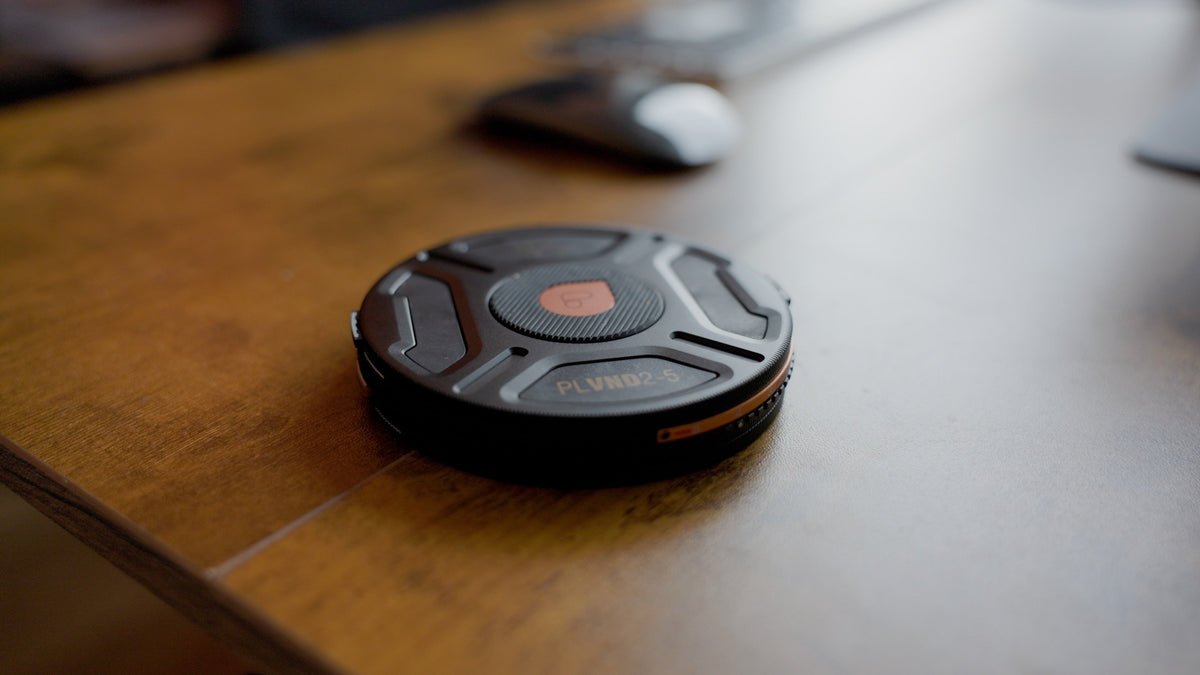
I bought this filter with my own money. No sponsorship from PolarPro, then or now.
It's also not new. I've been using it for over two years at this point, on client shoots, on personal work, tossed into the bottom of my backpack more times than I can count. There isn't a single scratch on it. That's the review in one sentence. Everything below is the version with detail.
The video below walks through the filter itself: how it attaches, how the two rings work, what two years of wear actually looks like. This post is the reference layer that goes with it. What the filter is officially called, what it costs to actually build out if you shoot on more than one lens, and how it compares to the closest thing NiSi makes.
What you're actually looking at
In the video, I just call it the "PolarPro PL VND, 2 to 5 stops." That's shorthand. The full name is the Chroma VND/PL Helix, part of PolarPro's Peter McKinnon signature line within the Helix MagLock system.
That naming distinction matters more than it sounds like it should, because PolarPro sells two genuinely different Peter McKinnon VND products right now, and they are not interchangeable:
- PMVND Edition II — the older, threaded line. ND only, no polarizer, screws directly into your lens. Not compatible with Helix MagLock base plates.
- Chroma VND/PL Helix — the one in the video. Combines an independently adjustable VND and polarizer in one filter, mounts magnetically, requires a separate base plate.
If you search "PolarPro Peter McKinnon VND," both will come up. Only the second one is magnetic and only the second one has a built-in polarizer.
Spec sheet, from PolarPro's own listing
| Spec | Chroma VND/PL Helix (2-5 Stop) |
|---|---|
| SKU | HLX-PL-2/5 |
| ND range | 2-5 stops |
| Polarizer | Independent, bi-rotational (separate from ND control) |
| Glass | Chroma Glass — PolarPro states zero color shift across both the 2-5 and 6-9 stop ranges |
| Outer diameter | 100mm |
| Mount | Helix MagLock (magnetic), requires a separate base plate |
| Included in box | 1x filter, front Defender, rear Defender, microfiber cloth |
| Price | $179.99 |
Also available: a 6-9 stop version, plus 2-5 and 6-9 stop variants with a built-in Black Mist (1/4 strength) or Gold Mist (1/8 strength) effect baked into the same filter. Worth knowing even if you don't need it yet, since that's the mist filter I mention wanting in the video and still haven't picked up.
One thing PolarPro's FAQ is explicit about: these filters won't work with your lens's stock hood, since a VND needs two glass elements rather than one and ends up wider as a result. Budget for shooting without a hood, or removing it when the filter's on.
What it actually costs to run this on more than one lens
The filter doesn't touch your lens at all. The magnetic mount is a separate Helix Base Plate, threaded onto the lens itself, sold in 67mm, 72mm, 77mm, and 82mm (brass), plus 86mm and 95mm coarse-thread sizes for larger zooms. Each base plate is $49.99 and includes its own Defender cap, so an empty plate still protects the front element when nothing's mounted.
This is exactly the setup I describe in the video: one filter, multiple base plates, one on each lens I care about. Buy the filter once, then it's $49.99 per additional lens rather than $179.99 per lens. For my Canon RF 24-70mm (82mm thread), that's:
| First lens | Each additional lens | |
|---|---|---|
| Chroma VND/PL Helix (2-5 Stop) | $179.99 | — |
| Helix Base Plate (82mm) | $49.99 | $49.99 |
| Running total | $229.98 | +$49.99 |
That per-lens marginal cost is the actual argument for the system, more than the magnetic swap speed. If you're a one-lens shooter, the swap speed is the whole story. If you run two or three lenses regularly, the base plate math is what makes the "it's pricey" complaint in the video easier to live with.
The two-ring workflow, and why it's not actually a flaw
The most common complaint about this filter online is the one I bring up in the video too: there are two rings that turn independently, one for the VND and one for the polarizer, and it's possible to nudge one while trying to turn the other.
PolarPro's own spec sheet confirms this is deliberate, not a design compromise: "Separate ND and Polarizer control" and "Preset Stop Range eliminates cross polarization" are both listed as features. The two elements are kept mechanically independent specifically so adjusting one doesn't drag the other with it, which is the exact problem that causes vignetting and the "X" pattern in cheaper stacked ND+polarizer setups.
In practice, after two years, this is a one-handed operation for me: hold the rear ring steady, twist the front one for stops, since exposure is what I'm changing constantly and polarization is the occasional adjustment. That workflow only works because the two controls are separate. A single combined ring would be faster to learn and slower to use well.
How this compares to NiSi's magnetic system
You've mostly shot with screw-in filters, so it's worth being clear about what the actual alternative looks like, since NiSi doesn't have a direct 1:1 competitor to the Chroma VND/PL Helix. The closest comparison is the NiSi JetMag Pro True Color VND, which is NiSi's own magnetic quick-swap system.
| PolarPro Chroma VND/PL Helix | NiSi JetMag Pro True Color VND | |
|---|---|---|
| Stop range | 2-5 (or 6-9) | 1-5 |
| Polarizer | Independent second ring | Built into the same ring — rotate past the ND hard-stops to adjust polarization |
| Filter price | $179.99 | $249.00 |
| Mount hardware | Helix Base Plate, $49.99 (brass) | JetMag Pro adapter ring, $21.99 (aluminum) |
| Cost for one 82mm lens | $229.98 | $270.99 |
| Cost per additional lens | +$49.99 | +$21.99 |
The mechanism difference is the one worth understanding before you buy either. NiSi's polarizer isn't on its own ring: you set your ND stop against a hard stop, then keep rotating the whole assembly, which shifts polarization without moving off your chosen exposure. PolarPro's two rings are physically separate from the start. Neither approach is wrong, but they produce a different feel in your hand, and it's the kind of thing that's hard to judge from a spec sheet.
Where NiSi pulls ahead is the math if you shoot on several lenses: their adapter ring is a third of the price of PolarPro's base plate, so a two- or three-lens kit closes the price gap with PolarPro fast, even though NiSi's single filter costs more up front.
If you're not ready to commit to either magnetic system, NiSi also sells the Swift System, which is the closer analog to the screw-in filters you've used before: a True Color VND that threads directly onto the lens like a traditional filter, with additional ND and mist filters pressing onto the front of it rather than mounting magnetically. It's a legitimate middle ground, but it doesn't include a polarizer in that base filter the way either magnetic system does.
Have you run a magnetic filter system, PolarPro or NiSi, across more than one lens? What did the base plate or adapter math actually look like for your kit? Drop it in the comments of my video, I would love to learn more from your experience.
Share:
The DJI RS 5 Tracking Fix I Promised, and What "Z-Axis Stabilization" Actually Means