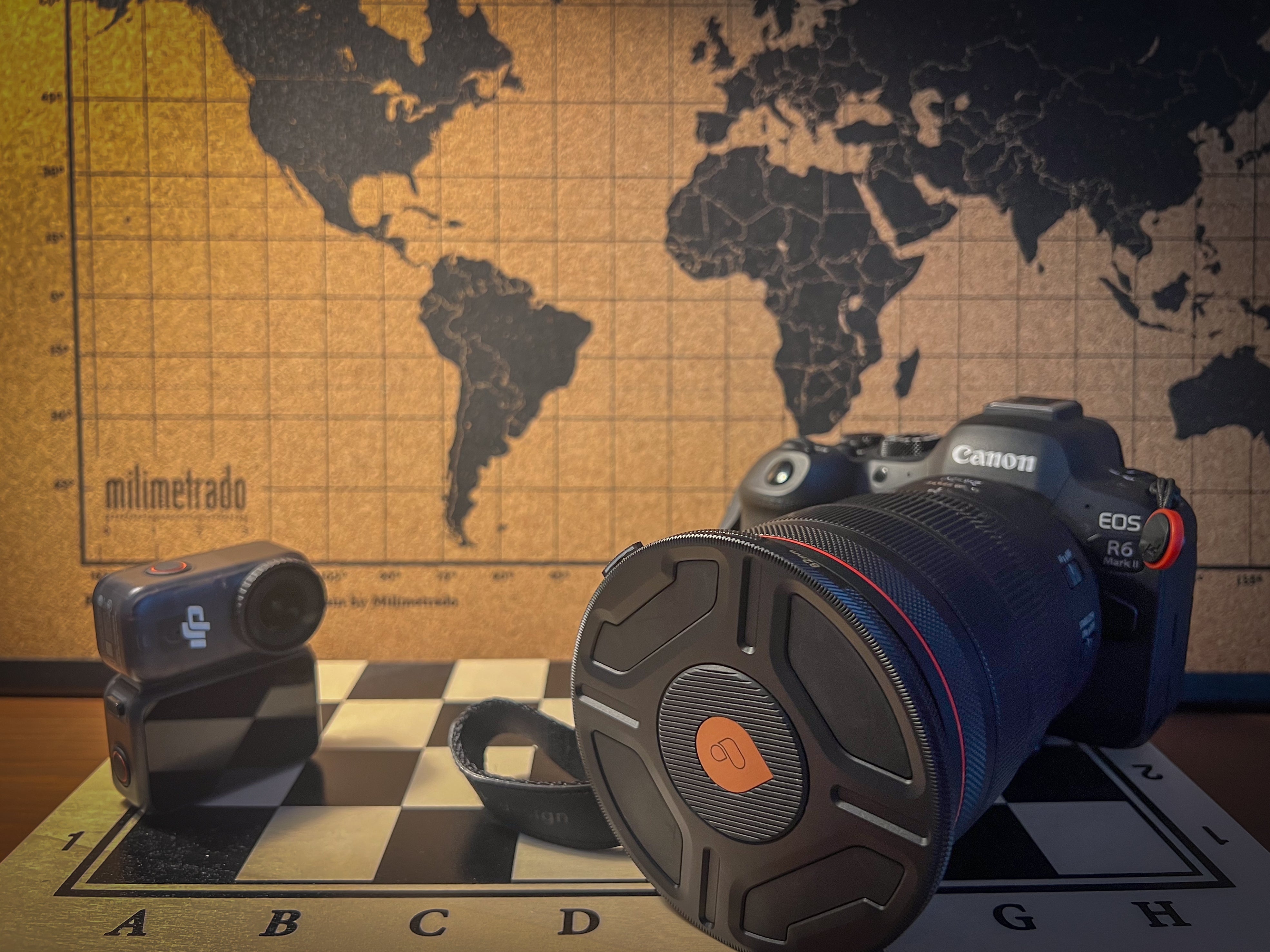
I own both of these cameras. Bought with my own money, no sponsorships, both used for real work.
The Canon R6 Mark II with the RF 24-70mm f/2.8 is the center of my professional setup. The DJI Osmo Nano is the small camera that lives in my pocket. And if you put their spec sheets side by side, you'd conclude nobody sane would ever compare them. One is a full-frame professional tool. The other weighs less than a protein bar.
Yet on my recent trip to Brazil, I packed both, and the Nano did most of the work while the R6 Mark II stayed in the bag. The video below shows how that played out on the ground (including one test I definitely couldn't have done with the Canon). This post covers what the video doesn't: the actual spec-sheet comparison, the one variable no manufacturer publishes, and how that variable rearranges everything.
The comparison on paper
Let's do the thing the internet says you shouldn't do and put these two on the same table. Specs pulled from Canon and DJI's official sheets:
| Canon R6 Mark II + RF 24-70mm f/2.8 | DJI Osmo Nano | |
|---|---|---|
| Sensor | 24.2MP full-frame CMOS | 1/1.3-inch CMOS, 35MP stills |
| Lens | Interchangeable, f/2.8 constant zoom (24-70mm) | Fixed f/2.8, 143° field of view |
| Video | 4K/60 oversampled from 6K, full sensor width | 4K/60 (16:9), up to 4K/120 slow motion |
| Color | 10-bit C-Log 3 | 10-bit D-Log M, 13.5 stops |
| Autofocus | Dual Pixel CMOS AF II with subject detection | Fixed focus, wide depth of field |
| Stabilization | IBIS + lens IS | RockSteady 3.0 + HorizonBalancing |
| Weather resistance | Weather-sealed, not waterproof | Camera module waterproof to 10m |
| Weight (shooting-ready) | Roughly 1.57 kg (body with battery plus lens) | 52 g camera module |
| Price (US, at time of writing) | Around $4,300 to $4,700 new for the combo | Around $300 to $410 depending on combo |
Read that table cold and the conclusion writes itself. The full-frame sensor gathers vastly more light. The interchangeable glass gives you real focal length choice. The autofocus tracks faces and eyes; the Nano doesn't focus at all in the traditional sense. On pure image quality, there is no contest, and I've never pretended otherwise. The Nano footage from this trip doesn't get close to what the R6 Mark II produces, and I say that as someone who genuinely likes the Nano.
Two rows, though, point somewhere interesting. The weight difference is roughly 30 to 1. The price difference is more than 10 to 1. Hold onto those, because they're about to matter more than the sensor.
The spec no manufacturer publishes: cost of loss
Here's the column missing from every spec sheet: what it costs you if the camera is gone.
Not depreciation. Gone. Snatched, dropped in a pool, left in a taxi. Every camera carries a loss value, and in most of Europe you can ignore it. In parts of Brazil, where I grew up and where I was traveling, you can't. Walking a city street with a rig that's visibly worth more than many people earn in months makes you a target, and locals know it. In coastal cities like Santos there are endless stories of phones snatched mid-shot by someone passing fast on the bike lane. A camera at arm's length is the same invitation, except worth ten times more.
So add the missing column to the table:
| R6 Mark II combo | Osmo Nano | |
|---|---|---|
| Cost if stolen | A four-figure financial hit | A bad afternoon |
| Visibility to a thief | Obvious professional gear, high resale value | Barely registers as a camera |
| Recording posture | Held at eye level, both hands, attention down | Chest-mounted, hands free, eyes up |
Suddenly the "worse" camera holds three wins that have nothing to do with image quality. The weight advantage isn't about your shoulder. At 52 grams on a chest mount, the Nano disappears into the scene, something I'd already noticed traveling with it through three countries, but which Brazil turned from a convenience into the entire reason footage exists. And the price advantage isn't about affordability. It's about what you're willing to have out of the bag in the first place.
The modular design earns an unexpected security role here too: the camera module records on your chest while the Vision Dock, the part that actually looks like a gadget worth grabbing, stays in your pocket. If you're not familiar with how the two-piece system works, I covered it in what the Osmo Nano's spec sheet doesn't tell you. DJI designed that split for mounting flexibility. In Brazil it functions as theft insurance.
The risk-adjusted decision framework
Once you accept that cost of loss is a spec, camera choice stops being "which is better" and becomes a per-situation calculation. This is the framework I ended up running for the whole trip:
| Environment | Camera | The math |
|---|---|---|
| Public streets, markets, traffic | Nano | High theft risk meets low loss value. Full-frame quality is worthless if the camera never leaves the bag |
| Private controlled events | R6 Mark II | Near-zero risk, and quality is the whole point. This was my son's first birthday party: full-frame, no hesitation |
| Resorts, semi-private spaces | Both | Enough security to justify the Canon, Nano on standby for water and casual moments |
| Pools and ocean | Nano, camera module only | Waterproof to 10m. The dock stays dry. The R6 Mark II's weather sealing means rain, not swimming |
| Beaches | Judgment call | Empty beach by the resort: Canon came out. Crowded public beach: Nano only |
One rule sits underneath all of it: decide what you're willing to lose before you leave the hotel, not while someone's eyeing your gear. Making the risk call in advance, calmly, means the street decisions are already made.
How this framework actually played out is in the video. I'll just say the pool footage alone justified bringing the Nano:
Insurance: the thing that changes the whole table
There's a second way to shrink the cost-of-loss column, and it's the one I didn't take: gear insurance.
I considered a policy before the trip and ended up winging it. Nothing happened, but I still think it was the wrong call, because of what it did to my behavior. Without coverage, the R6 Mark II stayed packed in environments where I might otherwise have risked it. With coverage, the cost-of-loss spec drops toward the deductible, and the spec-sheet winner becomes usable in far more places. Insurance doesn't just protect your gear. It buys back your best camera's advantage.
If you're pricing this out for your own travel, the questions that actually matter when comparing policies: does it cover theft outside your home country, does it cover theft from a hotel room or vehicle, what's the deductible relative to your combo's value, and does a claim require a police report filed locally. Those details vary wildly between providers and they're precisely the ones that decide whether a policy is real protection or paperwork.
I still haven't picked one. That's a genuine open item for me.
The honest summary
The spec sheet says the R6 Mark II wins, and it does: it's the camera I build my professional client setup around, and the footage it produced at the birthday party and the resort beach is in a different league from anything the Nano can do.
But spec sheets assume a world where the only risk to your camera is user error. Add cost of loss as a spec and the ranking flips depending on where you're standing. In Brazil, the best camera was usually the one nobody noticed and I could afford to lose. The lesson travels: match the camera to the environment first and the spec sheet second.
Do you run gear insurance when you travel, or do you wing it like I did? And if you insure, which provider and what did the fine print actually cover? Drop it in the comments. I'm reading them before I make my own call.
Share:
The DJI RS 5 Combo: Everything I Had to Research Myself (Because DJI's App Wouldn't Tell Me)
Synology vs. UGREEN vs. Mac Mini: The Boring Storage Decision I Can't Put Off Anymore